
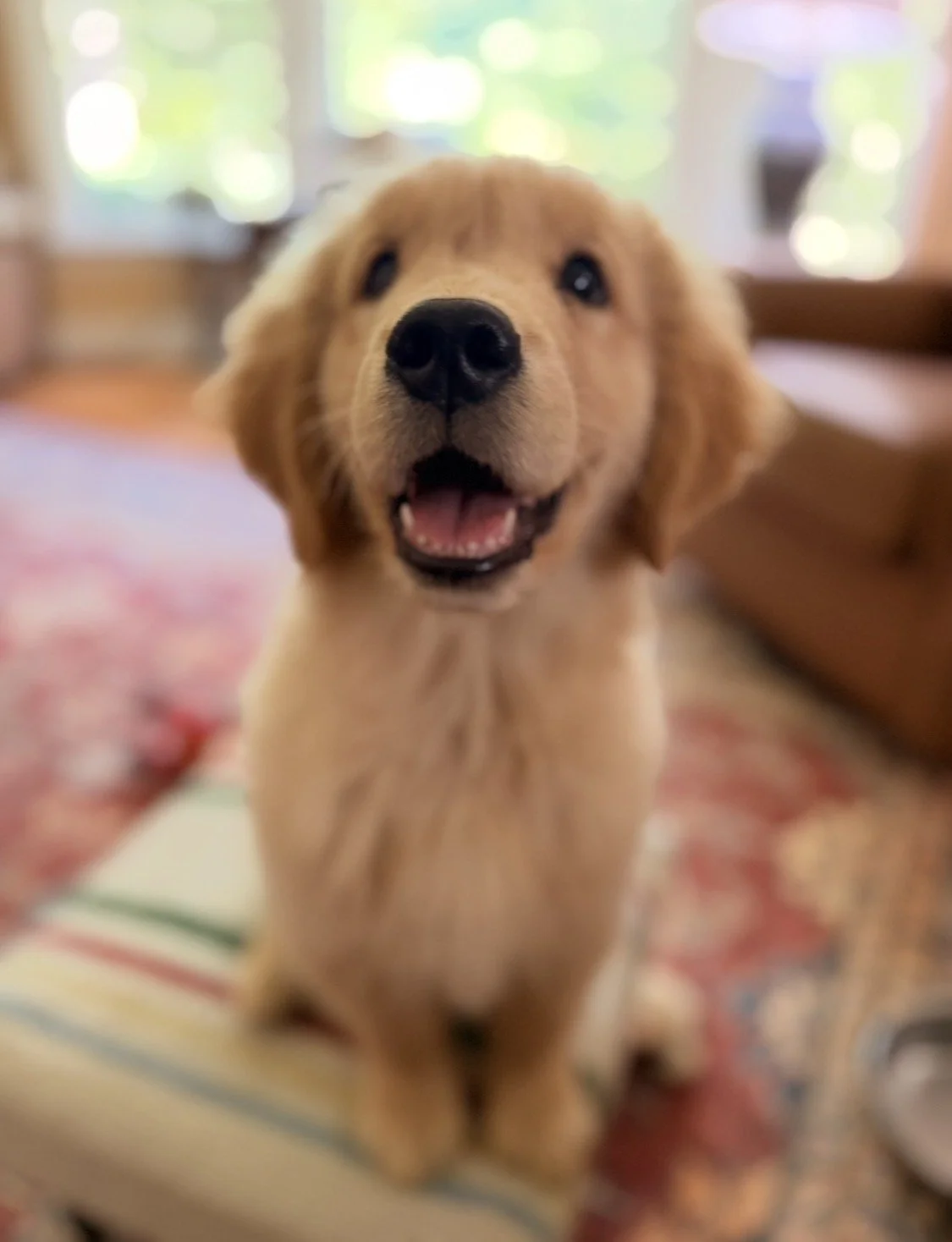
FIND THE RIGHT GOLDEN RULE PUPPY FOR YOUR FAMILY
Not every family wants—or needs—the same puppy experience. Some families cannot wait to bring home an eight-week-old puppy and begin training from the very beginning. Others would prefer to skip the sleepless nights, constant potty trips, puppy biting, and earliest stages of obedience training and bring home a puppy who has had more time to learn, mature, and develop good habits.
That is why Golden Rule Retrievers offers five levels of puppy preparation and training: Nursery, Preschool, Kindergarten, Intermediate, and Advanced. Each level builds upon the one before it, allowing families to choose the age, amount of training, and level of preparation that best fits their home and lifestyle.
As our puppies grow, training becomes more challenging. A command such as Sit may be introduced with a lure and reward when a puppy is very young. As that puppy progresses through our programs, we add duration, distance, distractions, different environments, handler movement, impulse control, and greater independence from food rewards. By the Advanced level, the goal isn't simply for the puppy to know a command—it is for the puppy to understand how to perform it appropriately in the real world.
Our extended training programs may be especially helpful for busy working families, homes with young children, families who value structure and good manners, prospective therapy-dog volunteers, those seeking a strong service-dog prospect, and businesses or organizations looking for a well-socialized mascot or ambassador.
No puppy leaves Golden Rule as a “finished” dog. Puppies and adolescents continue to mature, learn, and occasionally test boundaries long after they go home. What additional time with us provides is a stronger foundation, thousands of additional repetitions, broader experiences, and more practice learning how to look to people for direction.
Choose the level that fits your family—and we'll build from there.
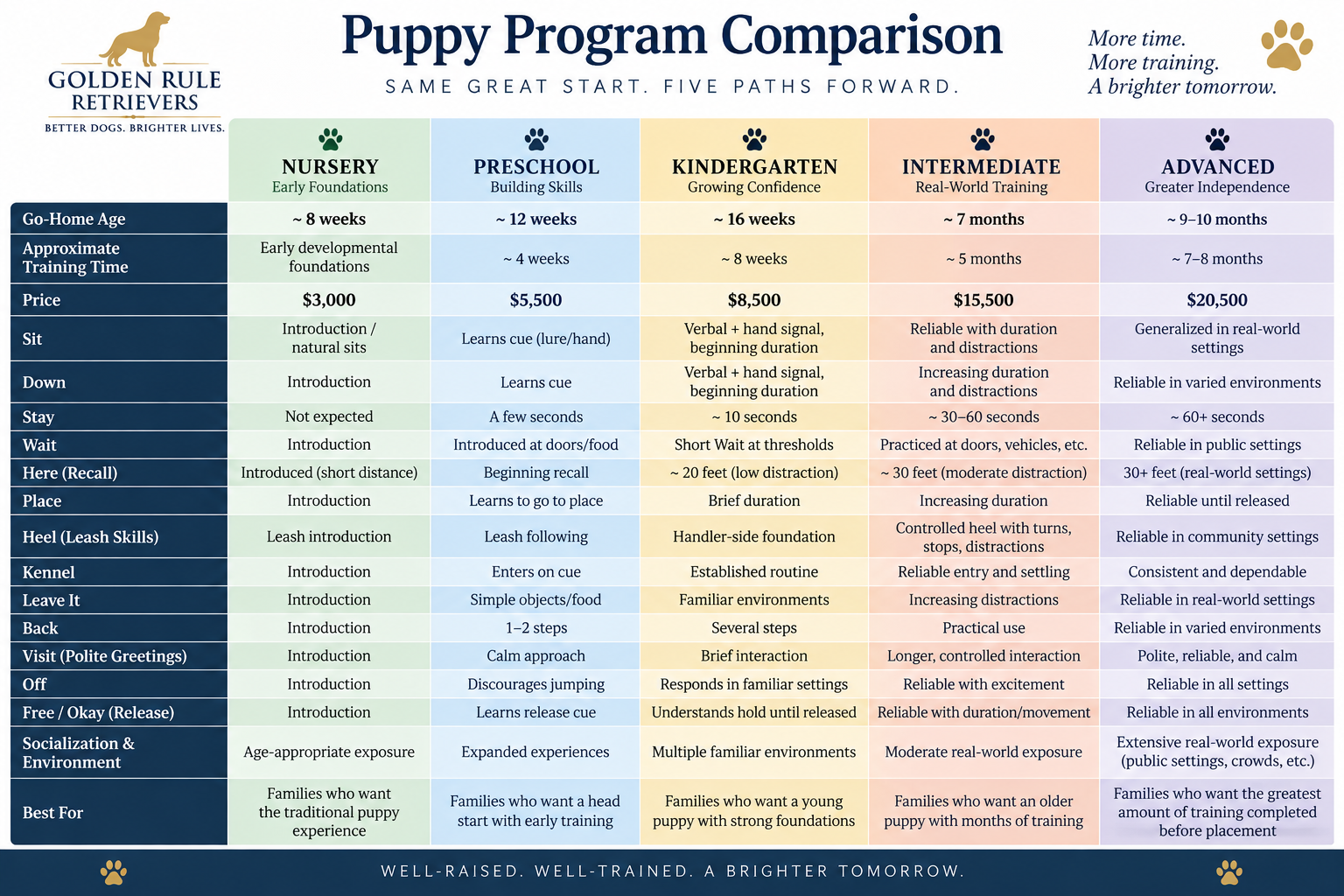
Golden Rule Retrievers Puppy Training Programs
Every Golden Rule Retriever begins with the same careful breeding, early handling, socialization, and developmental foundation. Families may choose the age and level of training that best fits their needs—from an eight-week-old Nursery Puppy to a nine- to ten-month-old Advanced Puppy with months of structured training.
Training is cumulative. A puppy in an Advanced program does not simply learn more commands; the puppy is expected to perform familiar commands with greater duration, distance, independence, distraction, and reliability in increasingly complex environments.
NURSERY PUPPY
$3,000 | Goes Home at Approximately 8 Weeks
Our Nursery Puppy is our traditional eight-week-old Golden Retriever puppy. From birth through eight weeks, our focus is healthy development, confidence, early socialization, handling, and preparing the puppy to successfully transition into a new home.
Training & Development
Sit — Early exposure through luring and naturally offered sits. There is no duration or reliability expectation.
Down — Early exposure through natural settling and gentle luring.
Here — Puppies are encouraged and rewarded for following and approaching people over short distances.
Kennel — Brief, positive introduction to entering and resting in a crate or kennel.
Leash — Brief introduction to a lightweight collar and leash when developmentally appropriate.
Potty Training — Puppies begin developing routines around waking, eating, playing, eliminating, and sleeping. Nursery puppies are not represented as house-trained at eight weeks.
Handling & Grooming — Regular handling of paws, ears, mouth, nails, body, and collar area; introduction to brushing, bathing, and grooming equipment.
Socialization & Environment — Age-appropriate exposure to adults, children, household activity, vehicle rides, everyday surfaces, household sounds, and controlled sound exposure.
Best for: Families who want the traditional puppy experience and are prepared to continue obedience, crate, leash, and house training at home.
PRESCHOOL PUPPY
$5,500 | Goes Home at Approximately 12 Weeks
Includes Approximately 4 Weeks of Structured Training
Preschool bridges the gap between a very young puppy and formal obedience training. Puppies begin learning the meaning of commands while continuing intensive socialization, crate training, potty routines, leash introduction, and confidence building.
Sit — Responds to the verbal cue with a lure and/or beginning hand signal. The emphasis is learning the command rather than holding it for duration.
Down — Responds to a lure/verbal cue and beginning hand signal. Reward is given quickly once the puppy reaches position.
Stay — Introduced for only a few seconds with the handler immediately beside the puppy and virtually no distraction.
Wait — Introduced at food bowls, kennel doors and simple thresholds for very short periods.
Here — Beginning recall over short distances in familiar, enclosed environments with very low distraction.
Place — Introduced to moving onto a designated bed or mat and remaining there briefly.
Kennel — Begins entering the kennel on cue and developing a predictable crate routine.
Leave It — Introduced using simple, low-value food or objects in a controlled setting.
Back — Introduced for one or two backward steps.
Visit — Begins learning to approach a seated person calmly with four feet on the floor.
Off — Introduced to discourage jumping or placing paws on people, furniture, or inappropriate surfaces.
Free/Okay — Introduction to a consistent release cue so the puppy begins learning that the handler—not the puppy—ends a command.
Leash Skills — Short sessions following the handler on a lightweight leash. Precision heel position is not expected.
Best for: Families who want to skip some of the most demanding early puppy weeks and bring home a puppy who has already begun structured training and household routines.
KINDERGARTEN PUPPY
$8,500 | Goes Home at Approximately 16 Weeks
Includes Approximately 8 Weeks of Structured Training
By sixteen weeks, training begins moving from introduction to understanding. Kindergarten puppies have had significantly more repetition and begin learning that commands apply in different familiar locations—not only in the original training area.
Sit — Responds to a verbal cue and hand signal with decreasing dependence on a food lure. Begins holding the position briefly before release.
Down — Responds to verbal cue and hand signal and begins maintaining the position briefly.
Stay — Approximately 10 seconds with minimal distractions. Handler remains nearby and begins introducing slight movement or a small amount of distance.
Wait — Short Wait at doors, gates, kennel exits, food bowls, and vehicle transitions.
Here — Recall from approximately 20 feet under familiar conditions with minimal distractions.
Place — Moves to a designated location on cue and remains briefly until released or given another instruction.
Kennel — Enters on cue and follows an established crate routine.
Leave It — Leaves stationary food or objects in familiar environments and begins working around mild temptations.
Back — Backs several controlled steps on cue.
Visit — Approaches and positions near a person for a brief, calm interaction.
Off — Responds in familiar settings and develops stronger four-feet-on-the-floor greeting behavior.
Free/Okay — Begins understanding that Sit, Down, Stay, Wait, and Place continue until the handler gives a release cue.
Leash/Heel Foundation — Develops appropriate leash-following habits and begins learning handler-side position, short straight lines, stops, and attention.
Best for: Families who want a young puppy but would prefer much of the earliest crate, potty, leash, and foundational obedience work already underway.
INTERMEDIATE PUPPY
$15,500 | Goes Home at Approximately 7 Months
Includes Approximately 5 Months of Structured Training
Intermediate training is where obedience begins becoming practical. Instead of simply demonstrating that the puppy understands a command, we begin increasing duration, distance, distractions, handler movement, and the number of environments in which the puppy is expected to perform.
Sit — Responds to a verbal cue or hand signal without needing to see food first. Builds duration while the handler changes position or moves away.
Down — Responds to verbal cue or hand signal and maintains position for increasing duration while the handler stands or moves.
Stay — Builds toward approximately 30–60 seconds. Duration, distance, handler movement, and distraction are progressively increased.
Wait — Practiced at household doors, kennel gates, vehicle doors, and controlled public thresholds.
Here — Recall develops to approximately 30 feet in familiar controlled environments with moderate distractions.
Place — Goes to Place from increasing distance, settles, and remains there for useful periods while the handler moves nearby.
Heel — Walks in controlled handler position with starts, stops, turns, and pace changes. Training expands into familiar outdoor environments and moderate distractions.
Kennel — Prompt entry on cue, settling, age-appropriate duration, and an established crate and exit-to-potty routine.
Leave It — Leaves increasingly interesting food, toys, and environmental objects and begins applying the skill during walks.
Back — Backs several steps on cue and begins using Back practically at doors and in confined spaces.
Visit — Calmly approaches and remains beside or near a person for a longer interaction.
Off — Responds around household guests and during increasingly exciting greetings.
Free/Okay — Holds trained positions through increasing duration and handler movement until specifically released.
Environment — Training expands beyond the home and training room into safe, controlled real-world settings. A Gentle Leader may be introduced when appropriate.
Best for: Families who want to bypass most of puppyhood and receive an older puppy with months of structured obedience, household routines, leash work, and real-world training.
ADVANCED PUPPY
$20,500 | Goes Home at Approximately 9–10 Months
Includes Approximately 7–8 Months of Structured Training
Advanced training focuses on generalization—teaching the adolescent dog that the same rules and commands apply even when the environment changes.
An Advanced Puppy remains a young dog and will continue maturing after placement, but has received extensive structured training and real-world experience before going home.
Sit — Responds promptly to verbal cue or hand signal in home, training, community, and selected public environments. Maintains position until released through manageable distractions and handler movement.
Down — Performs and maintains Down until released across varied practiced environments, surfaces, and manageable distractions.
Stay — Target of at least approximately 60 seconds, with increased handler movement, useful distance, and manageable distractions.
Wait — Used as a practical safety command at doors, vehicles, entrances, exits, automatic doors, and other practiced transitions.
Here — Recall from at least approximately 30 feet under familiar/practiced conditions with manageable distractions.
Place — Moves to the designated location, settles, and remains until released or given further instruction.
Heel — Controlled walking with the handler in familiar settings and selected public/community environments, including real-world movement through entrances, parking areas, and crowds.
Kennel — Established crate routine with controlled entry, settling, resting, and exit behavior.
Leave It — Disengages from practiced food, dropped objects, and environmental distractions while stationary or moving.
Back — Moves backward on cue for practical positioning around people, doors, objects, and confined spaces.
Visit — Performs a controlled, calm interaction with a person and disengages when directed by the handler.
Off — Promptly disengages from people, objects, and inappropriate surfaces despite manageable excitement.
Free/Okay — Clearly understands that a command remains in effect until released or given another instruction.
Advanced Environmental Training
As vaccination status, maturity, temperament, and individual readiness permit, Advanced training may include controlled exposure to automatic doors, parking lots, shopping carts, crowds, varied surfaces, loading and unloading from vehicles, lawn ornaments, balloons, small animals, and appropriate greetings with people and dogs. Your current Advanced Agreement already identifies these as part of the real-world exposure progression.
Best for: Families who want the greatest amount of training completed before placement and want an adolescent puppy with substantial obedience, household, leash, social, and real-world experience.
**Training targets are age-appropriate developmental goals. Puppies and adolescent dogs are living animals, and individual maturity, temperament, health, fear periods, and environmental changes can affect performance. Continued training and consistent handling are required after placement.
***Program labels and descriptions below are valid for agreements signed prior to September 14, 2026
Our board and train program offers three levels!
Please contact us if you would like to customize a plan
At this time, we do not board or train dogs that are not born and raised on our property
Kindergarten
$5400
Puppies begin training at 8 weeks old
Go home at 12 weeks old
(includes Cost of Puppy $3,000, 4 Weeks of Kindergarten $2,400, vaccines, boarding, food, treats, supplies)
Commands - all are taught and reinforced using treats, luring and rewards.
Sit - verbal and sign
Down - verbal and sign
Stay - verbal and sign for 10 second duration
Here - come when called from 20’ with minimal distractions
Place - move to a designated spot and sit, wait for further instructions
Socialization (Please note that puppies are not fully vaccinated until 16 weeks old and may not enter public spaces until then)
Held by and interacting with men, women and children of all ages
Vet visits
Riding in the vehicle
Playing with humans in our clean puppy playground and indoor environment
Comfortable being bathed and groomed (including dryer)
Tolerate vacuum, washer/dryer, hair dryer, doors closing/slamming
Exposure to sounds: baby crying, garbage truck, gunshots, thunder, fireworks
Leash Training
Begin leash training by allowing puppy to wear the leash while supervised in the house. When outside, allowing for slack and providing opportunities for the puppy to self-correct before moving forward
Potty/ Crate Training
Can be crated at night for 3-4 hours without having an accident
Conditioned to release from crate and go immediately to door/outside
Note that your puppy will not be completely potty trained and should not be left in the house to wander
Crates without resistance or anxiety in case of emergency
Intermediate
$10,500
Puppies begin training at 8 weeks old
Go home at 5 months old
(includes Cost of Puppy $3,000, 12 Weeks Training $7,500, vaccines, boarding, food, treats, supplies)
Commands - all are taught and reinforced using treats, luring and rewards.
Sit - verbal and sign
Down - verbal and sign
Stay - verbal and sign for 60 second duration
Here - come when called from 30’ with minimal distractions
Place - move to a designated spot and sit, wait for further instructions
Socialization (Please note that puppies are not fully vaccinated until 16 weeks old and may not enter public spaces until then)
Held by and interacting with men, women and children of all ages
Vet visits
Riding in the vehicle
Playing with humans in our clean puppy playground and indoor environment
Comfortable being bathed and groomed (including dryer)
Tolerate vacuum, washer/dryer, hair dryer, doors closing/slamming
Exposure to sounds and experiences: baby crying, garbage truck, gunshots, thunder, fireworks, automatic doors, lawn ornaments, balloons, shopping carts, small animals)
Introduction to crowds, parking lots, greeting humans and other dogs, loading/unloading the vehicle
Leash Training
Walking with a loose leash in the heel position with the help of a Gentle Leader
Automatic sit when human stops
Potty/ Crate Training
Can be crated 7-8 hours without having an accident
Crates without resistance or anxiety in case of emergency
Conditioned to release from crate and go immediately to door/outside
1-2 hours supervised free in house with no accidents during daytime hours
(Accidents may happen when puppy is adjusting to your home, but if you follow our instructions, accidents can be avoided)
Advanced
$20,500
Puppies begin training at 8 weeks old
Go home at 9-10 months old
(includes Cost of Puppy $3,000, 28 Weeks Training $17,500, vaccines, boarding, food, treats, supplies)
Commands
Sit - verbal and/or sign
Down - verbal and/or sign
Stay - verbal and/or sign until released
Here - come when called from a distance using verbal and/or sign
Place - move to a designated spot and sit, wait for further instructions
Socialization
Held by and interacting with men, women and children of all ages
Vet visits
Riding in the vehicle for long durations
Playing with humans in our clean puppy playground and indoor environment
Comfortable being bathed and groomed (including dryer)
Tolerate vacuum, washer/dryer, hair dryer, doors closing/slamming
Exposure to sounds and experiences: baby crying, garbage truck, gunshots, thunder, fireworks, automatic doors, lawn ornaments, balloons, shopping carts, small animals)
Familiar with crowds, parking lots, greeting humans and other dogs, loading/unloading the vehicle
Comfortable walking in heel position through stores, going under table restaurants, moving through crowds, greeting in schools, social settings
Leash Training
Loose leash walking in heel position
Potty/ Crate Training
Ability to be crated overnight for 8 hours without having an accident
Fully housebroken, familiar with the potty command
Crated without resistance or anxiety in case of emergency
Conditioned to release from crate and go immediately to door/outside
3-4 hours supervised free in house with no accidents during daytime hours
(Accidents may happen when puppy is adjusting to your home, but if you follow our instructions, accidents can be avoided)
ADVANCED ADD-ONS
Ring Dog Doorbell - $1500
Pick It Up - $1500
200 Therapy Hours - $4000
Boarding/Refresher Training/Boot Camp - $625/week